
What a new roof costs in Connecticut and what changes the price
By Hannah Haddad · Updated 2026-06-17
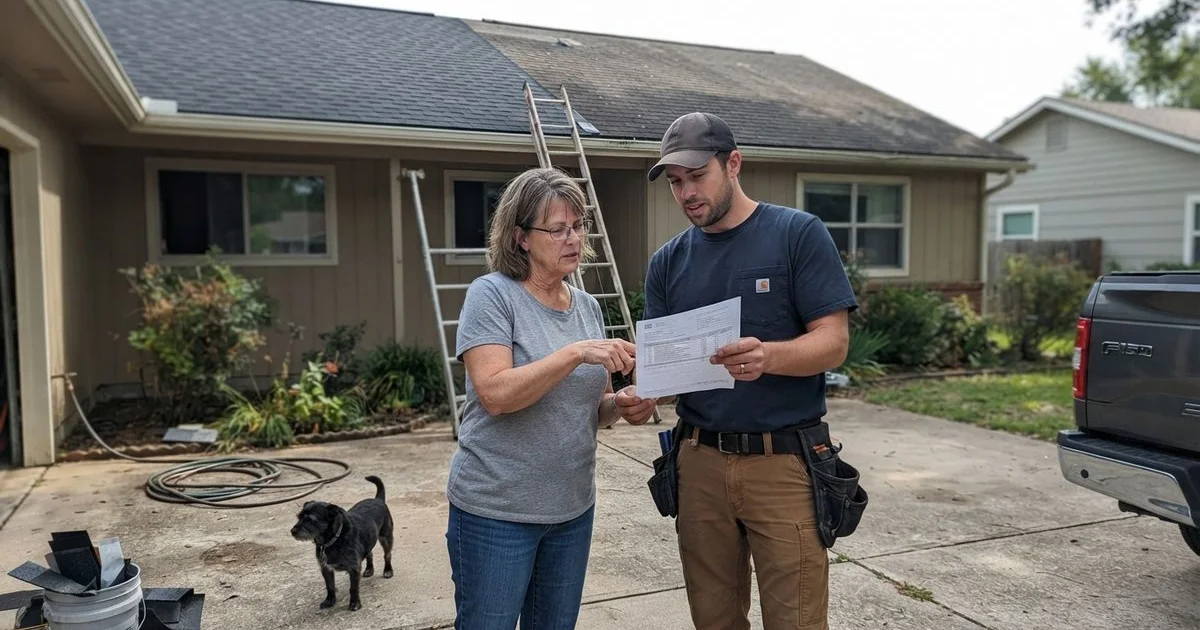
Ask five roofers to bid the same job and you’ll usually get five different numbers, sometimes a few thousand dollars apart. None of them are necessarily wrong. The gap almost always comes down to what’s included in the number, not just how the contractor prices labor.
For homeowners working through a roof replacement or new installation, the goal isn’t finding the lowest bid, it’s understanding what’s driving the difference so you can compare quotes on equal footing.
Typical price ranges
For a standard single-family home with an asphalt shingle roof, expect a range roughly from $9,000 to $18,000 for a full tear-off and replacement. That range moves depending on square footage, roof pitch, how many old layers need removing, and whether the crew finds rotten decking once the old shingles come off. Metal roofing runs considerably higher, often $9 to $16 per square foot installed, with a typical single-family re-roof landing between $15,000 and $30,000. Slate and complex custom rooflines push past that.
These are starting points, not quotes. The only way to get a real number for your house is a written estimate after someone actually looks at the roof.
What actually moves the price
| Factor | Effect on cost |
|---|---|
| Roof pitch | Steep, hard-to-walk roofs cost more in labor and safety equipment than a gentle slope |
| Tear-off layers | Removing two old layers costs more than a single-layer tear-off |
| Decking condition | Rotten plywood found under old shingles adds material and labor per sheet |
| Material choice | Architectural shingles cost more than 3-tab; metal and slate cost more than either |
| Roof complexity | Valleys, dormers, skylights, and chimneys all add flashing labor |
| Access | A roof surrounded by landscaping, a pool, or tight setbacks slows the crew down |
Two roofs with identical square footage can price thousands apart once pitch and complexity are factored in.
Reading a quote correctly
A single lump-sum number tells you almost nothing. Ask each contractor to itemize material brand, underlayment type, whether ice-and-water shield is included along eaves and valleys (it should be, code requires it in this climate), and how decking repair is billed if they find rot. A contractor who quotes a per-sheet rate for decking repair up front is being straight with you; one who says “we’ll figure that out once we open it up” without a rate in writing is leaving room for a surprise invoice.

Financing and payment structure
Most contractors ask for a deposit, often a third of the total, with the balance due on completion or in stages tied to milestones like tear-off and final inspection. Paying the full amount up front before any work starts is not standard practice and is worth questioning. Some companies offer financing plans through third-party lenders; if you’re considering one, read the interest terms carefully; a low monthly payment can mask a rate that costs far more over the loan’s life than paying cash would.
Is it worth paying more for a better warranty?
A manufacturer’s extended warranty usually requires using a certified installer and sometimes costs more up front, but it can matter if a shingle defect shows up in year eight rather than year one. Ask what the warranty actually covers: materials only, or materials and labor, and for how many years. A workmanship warranty from the contractor separate from the manufacturer’s warranty is worth having in writing regardless of which shingle you choose.
Confirm, too, that the contractor actually registers the installation with the manufacturer once the job wraps up. Some extended warranties are voided from the start if this paperwork step gets skipped, which only becomes apparent if you ever need to file a claim.
Getting quotes you can actually compare
Get at least three written estimates before deciding anything. Line them up side by side against the factors above rather than just the bottom-line number, and ask follow-up questions where one quote is noticeably higher or lower than the others. Once you accept a bid, our guide to what to expect during a full roof replacement, step by step covers the job from tear-off to cleanup. See our methodology for how we score contractors on more than price alone, and browse the full directory of options serving Greater Hartford.
FAQ
- What does a typical roof replacement cost in Connecticut?
- Most full asphalt shingle replacements on a single-family home run roughly $9,000 to $18,000, depending on size, pitch, tear-off layers, and any decking repair. Metal, slate, or complex rooflines cost more.
- Why do quotes for the same roof vary so much between contractors?
- Differences usually come from labor rates, whether decking repair is included or billed separately, the shingle brand and warranty tier, and how much underlayment and flashing detail is specified rather than assumed.
- Does roof size alone determine the price?
- No. Pitch matters almost as much: a steep, hard-to-walk roof costs more to work on than a low-slope one of the same size, and a roof with multiple valleys or dormers adds labor beyond the square footage.
- Is a low quote ever a red flag?
- Yes, if it's well below the others for the same scope. It often means thinner underlayment, no allowance for rotten decking, or a crew planning to cut corners on flashing, which shows up later as a leak.